
Interview with David Balfe of Late Transmissions
Updated: Jun 13
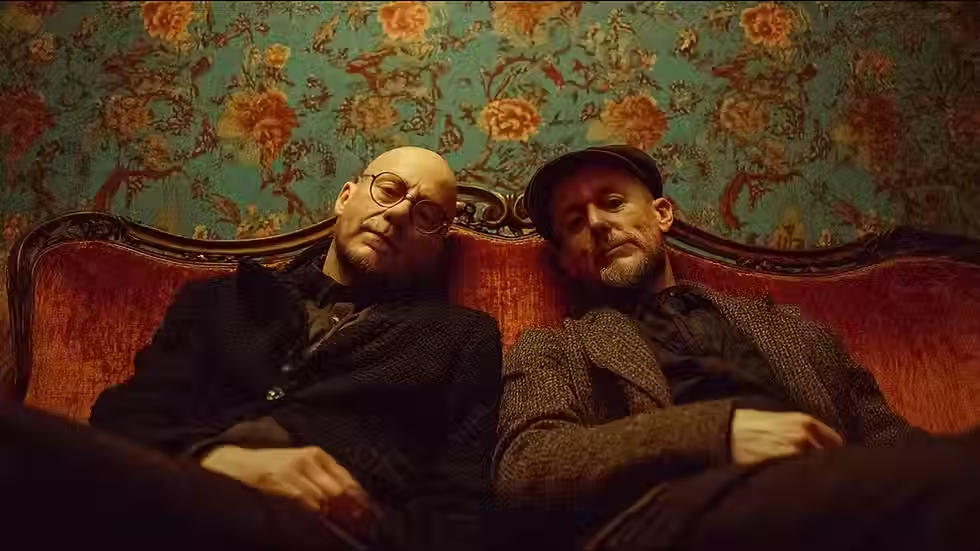
Firstly, I’m going to confess this is a not a verbatim transcription of the interview I was lucky enough to have with David Balfe.
We talked for an hour and if I wrote down everything we talked about it would probably take me days to get it into some semblance of a proper interview and it would be so long my editor probably wouldn’t publish it.
However, I’ve tried to distil it down, so it gets published, but I don’t think I’ve spent a more enjoyable hour, ever, talking to someone about music.
David is a legend, you may not, as yet, have heard of his new band Late Transmissions (go read the review of their debut album here and give it a listen, you won’t regret it) but you will know The Teardrop Explodes, for whom he played keyboards, or have bought music put out by one of the labels he founded, Zoo or Food (two highly influential independent labels ), heard his band Lori and the Chameleons (along with Bill Drummond of KLF fame with whom he cofounded Zoo records) or, if nothing else you may have heard the band he discovered and signed called Blur and if you’ve ever heard Country House by that self-same band then you might know they wrote it about him.
So having said all that he is just a lovely man who has so many stories and anecdotes but more importantly a new band, Late Transmissions, who have their debut album out now and what an album it is, it’s like nothing else out there just now and deserves to achieve as wide an impact as possible.
Lovey to meet you David, even if it virtually, thanks for taking the time to talk to me today.
Great to be here and thanks for the review you wrote of the album.
No need for thanks, I loved the album so much I bought it on vinyl.
Great, it’s something new for me, David and Eve, it’s something I started talking to David about 3 years ago, so it’s taken a while to come to fruition.
So how did the band come together?
I’ve known Dave (David Hughes, Producer and film/television score writer) a long time, we have talked on and off about doing something together, but we finally started to get an idea for something I am calling Orchestral pop and decided we would try to create it. I’m a big fan of Burt Bacharach amongst others and I wanted to create something like that.
It a leap from the kind of music you used to play.
Most alternative music these days doesn’t really excite me. I find some good stuff but it’s not where I’m at any more. If I’m honest, I’m a bit bored by guitar music. That process started some time ago and saw me become much more interested in Electronica and Futurist music.
You really can’t accuse this album of being any of those things!
What I wanted to create, and I’ll let others judge if I managed it, was perfect orchestral pop songs. I wanted something that sounded original and yet classic. I wanted to know about lyrics and not just have them as an afterthought; I wanted them to drive the song and be discernible and understandable.
Is there a reason for that?
I honestly think cryptic lyrics hold people back, they don’t connect with those who listen and while you can admire the songs and the talent, they will never have a deep emotional impact. This album is a big concept. I think of these as story songs and of this album as cinematic music.
What prompted you to follow this route?
The problem with me is I’ve spent 25 years thinking about the music business. I can’t stop myself, maybe I shouldn’t but I care deeply about it and it’s been my life. I know on this album some people will say some of the rhythms sound corny, but I don’t care. The thing is, on the whole album there are no guitars or orchestra, no synth.
It’s a long way from where you started.
I started in a Punk band but then I ‘procured’ a synthesiser as I knew it wasn’t for me, I seem to remember Andy McLuskey was involved in the process somewhere of me moving to electronica. At this point Dave Hughes was still at school, and later I was hanging out with Bill Drummond. Bill and I released a song called The Lonely Spy by Laurie and the Chameleons which you should listen to some time.
So how did you and Dave end up teaming up with Eve?
Dave had been in a band with a singer called Thomas Lang who still lives in Liverpool. We had looked on the internet. Had a search and couldn’t find anyone. Thomas Lang recommended Eve. We got her over to the studio in Birkenhead. She sang on a couple of songs, and we knew we had something special; we moulded new songs to go with the vibe of her voice. She is a tragic, romantic, slightly scary, torch singer.
So how do you work together?
Eve sends the songs to Dave and gets his notes on them, Dave and I then work together and build it from scratch bringing Eve in at different points in the process. Problem is these days there are so many tribes of music, but we don’t have one phrase I would use to describe it is weird pop. I am grateful I’m not starting from scratch in music now, there are so many sub genres, so much diversification and splintering that it’s really hard for an act to find their audience. Even if they do sometimes, they get so narrow they struggle to have a wider impact. I still remember listening to the charts on a Sunday, it was exciting then, now it feels like it’s harder to make your mark.
So what next?
I would love to carry on making it, right now we are working out what to do next. We need to find out audience and are going to put out a couple of more tracks.
Thanks David, I’m conscious I only asked for 30 minutes of your time and have taken an hour, I have loved talking to you and think this album deserves a very wide audience.
Thanks for your time and the support.
Interview - Iain McClay


Comments